
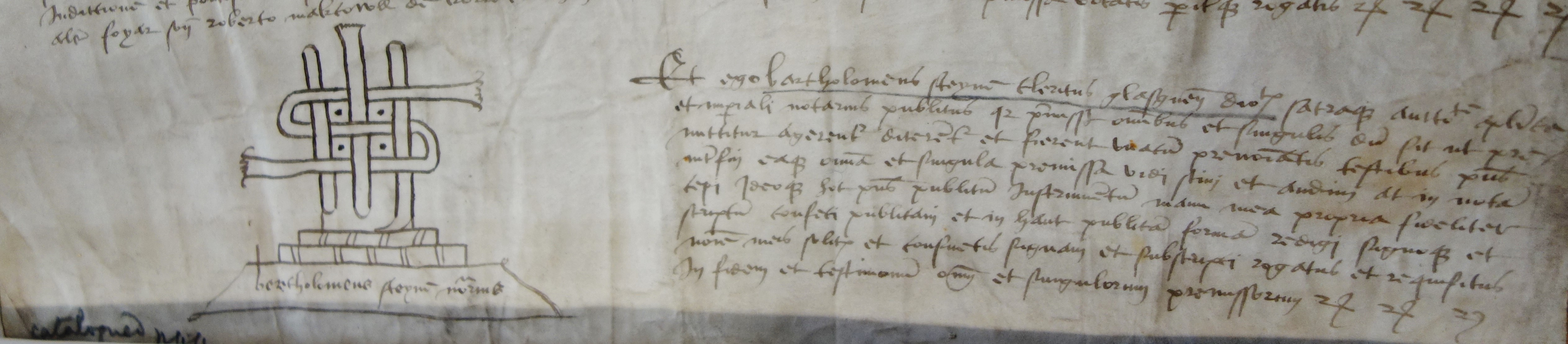
Muniment Hill 81 was created in Latin on November 10th, 1548, and is a sasine (land deed). It was written by Bartholomew Steyne a clerk and notary public in Glasgow Diocese. You can notice in the image above how he adds a graphic to the muniment. It is for Portincaple, Garboyle, Ardlui, Garrowstuke, Stukendroin, Ardmerlik, Lumquhilling, Blairdryth and Stronafyne and their pertinents (something which belongs to or is attached to the land) for liferent. Liferent means until death or some other specified contingency and without the right to dispose of the capital. These lands are in the Earldom of Lennox in the County of Dunbarton. This sasine is between the late Duncan Macfarlane the 13th Baron of Arrochar and 10th Chief and Katherine Culquhoun his spouse.
This muniment has now been translated/transcribed and is available for CMW members to read on the website.
Be sure to login at the website first, then select "Clan MacFarlane" from the menu and then select "Muniments". The actual .pdf file will be available for you to open at the bottom of the page. Cheers!
Open the Read more, sign in if you haven't already, and the pdf below will open the issue. Enjoy!
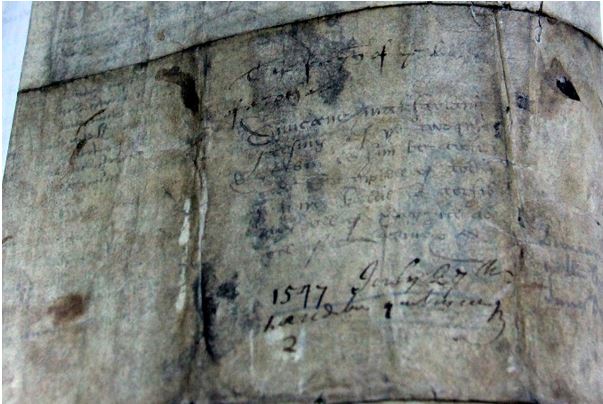
Muniment Hill 80 was created in Latin on July 27th, 1547, and is an Instrument of Sasine (land deed) to Dunchanus (Duncan) Makferland. Duncan Mcfarlane was the 13th Baron of Arrochar and 10th Chief of Clan MacFarlane. Duncan was the son and heir of Andrew Macfarlane, “The Wizard”, the 12th Baron of Arrochar, and the 9th Chief of Clan MacFarlane. Duncan sided with the Earls of Lennox and Glencairn who were in 1544 and 1545 still supporting the marriage of a young Prince Edward of England the son of King Henry VIII to Mary Stuart Queen of Scots. Mary's father was King James V of Scotland and her mother Mary of Guise who he married to strengthen the Auld Alliance with France. King James V died when Mary was about a week old and he had previously lost two sons in 1541 and now had no living heirs other than Mary. Duncan, aligned with the Earls, fought James Hamilton the Regent Arran for the infant Queen Mary of Scotland and their adherents and the Catholic Party but were defeated in the Battle of Glasgow Muir in 1544. Duncan then forfeited his lands, but Duncan had powerful friends. In 1546 he was granted remission or pardon Duncan for his treasonable remaining away (no show) when there was a royal proclamation to muster on Roslin Moor on July 28th of 1545. This sasine appears to be the result of his powerful friends supporting him to get back this land deed for Arrochar McGilchrist. One of these supporters appears to be Archibald Campbell, the 4th Earl of Argyll.
Duncan would die less than two months later at the Battle of Pinkie Cleugh along with many of his clan, among others his uncle Walter MacFarlane of Gartartan, 1st Baron.
This muniment has now been translated/transcribed and is available for CMW members to read on the website.
Be sure to login at the website first, then select "Clan MacFarlane" from the menu and then select "Muniments". The actual .pdf file will be available for you to open at the bottom of the page. Cheers!
Open the Read more, sign in if you haven't already, and the pdf below will open the issue. Enjoy!

Muniment Hill 79 was created on October 6th, 1546, and is basically a duplicate of Muniment Hill 4. There was no reason to fully translate and document Hill 79 due to the duplication although the summary document is being posted so readers will be aware of this fact. Muniment Hill 4 was also created October 6th, 1546. For the full translation see Hill 4. After translation Hill 4 was published in the Loch Sloy in September of 2022 and has been available for CMW members to read on the website since 2022 under Muniments.
This period of turmoil was known as the "Rough Wooing" of the young Mary Queen of Scots. Duncan Mcfarlane the 13th Baron of Arrochar and 10th Chief sided with the Earls of Lennox and Glencairn who were in 1544 and 1545 still supporting the marriage of a young Prince Edward of England the son of King Henry VIII to Mary Stuart Queen of Scots. Mary's father was King James V of Scotland and her mother Mary of Guise who he married to strengthen the Auld Alliance with France. King James V died when Mary was about a week old and he had previously lost two sons in 1541 and now had no living heirs other than Mary. Duncan, aligned with the Earls, fought James Hamilton who was the Regent Arran for the infant Queen Mary of Scotland and their adherents the Catholic Party but were defeated in the Battle of Glasgow Muir in 1544. Duncan then forfeited his lands, but Duncan had powerful friends. In 1546 Hill Muniments 4 & 79 document the remission or pardon to Duncan for his treasonable "remaining away" (no show) when there was a royal proclamation to muster on Roslin Moor on July 28th of 1545 to resist our old enemies of England.
Be sure to login at the website first, then select "Clan MacFarlane" from the menu and then select "Muniments". The actual .pdf file will be available for you to open at the bottom of the page. Cheers!
Open the Read more, sign in if you haven't already, and the pdf below will open the issue. Enjoy!