
Purthe Mackfarlin (Purdy Macfarland): First McFarlane settler in the Americas
Compiled by Mary Helen Haines © 2024
Updated, and Edited by Peter McFarland © 2026
I have looked at Purthe Mackfarlin over the years, but never really attempted to research him until making contact with Molly MacFarland Gardner a few weeks ago. We have three members who descend from Purthe; here I will rely on records and research that have been discovered.
Purthe’s birth year is not known for certain. He married in 1667 in Hingham, Massachusetts, received his first property in 1669-70, and died in 1721. So, his birth could be around 1644.
The spelling of Purthe’s name is all over the place. His first name is sometimes Purthe, or Parthee, or Purdy with various surname spellings such as Mackfarlin, Magvarlo, Mackvarlow; but by 1721 in two deed documents in Plymouth County, it is spelled MacFarland. However, in the record of his death in Hingham, his name is spelled Purthe Mackverlo.
I did a search of Old Parish Records at Scotland's People site for all McFarland males (every spelling) born between 1630 and 1655. The only close match was a Parlon McFarlon b. 1650 in Kenmore to a Patrick McFarlon and Margaret Nikawis. I used every possible spelling of MacFarlane, and in the latter date range the most common spelling in Scotland’s church records was “McFarland.” I thought that was interesting, because we always associate that spelling with Ireland, but it was the style used in Scotland as well during this time.
No one knows exactly when or how Purthe/Purdy arrived in Hingham, a Scot among the English Puritans. One speculation was that he arrived as a POW from Scotland on the ship Unity in November 1650. This comes from a list made by an American researcher George Sawin Stewart in 1911. “Purdie McFarland” is on a list of men who were supposedly captured at the Battle of Dunbar in 1650 by Cromwell and then sent to the Massachusetts colony where they were sold as indentured servants by the ship’s owner.
The full list is available online:
http://spows.wpengine.com/battle-of-dunbar/dunbar-documentation/george-sawin-stewart-documents/
However, there is no known manifest of the ship's passengers, and Mr. Stewart did not provide his source. It is also possible Purthe came as an indentured servant around 1660, without family, served his seven years and then was free to marry and settle down in 1667. At this stage, this is only speculation.
A more recent evaluation of the prisoner list is found in Lost Lives, New Voices: Unlocking the Stories of the Scottish Soldiers at the Battle of Dunbar, 1650 by a team of researchers, published in 2018. In Appendix A, they list all the men who had appeared on earlier lists and rate them as Definite, Probable, Possible and Doubtful. Purthe falls into the doubtful range because of his very late arrival. https://spows.org/battle-of-dunbar/dunbar-documentation/list-of-dunbar-prisoners-from-lost-lives-new-voices/
McFarland/MacFarland/Macfarlo/Macvarlo/MagvarlowMackfarlo/Mcfarlin, Purdie/Purde/Purthe
Residences: Hingham MA. Appears: 1667. D.1721. Appears very late for a Dunbar prisoner. Probably a later migrant. [Exiles; DR; SPOWS; Ch.8]
The earliest primary source document found so far is Purthe’s marriage to Patience Russell in Hingham on July 3, 1667.

Patience was the daughter of George and Jane Russell, both from England. Jane Russell was born in Hingham, Norfolk County, England, home of most of the first inhabitants of Hingham Massachusetts. She married Philip James in England, but he died in 1639, shortly after arrival in New England. Jane then married George Russell and gave birth to Patience in 1647 in Hingham. Jane Russell’s grave monument is the oldest still existing gravestone in the High Street Cemetery. The cemetery dates to 1681 and her tombstone is dated 1688.
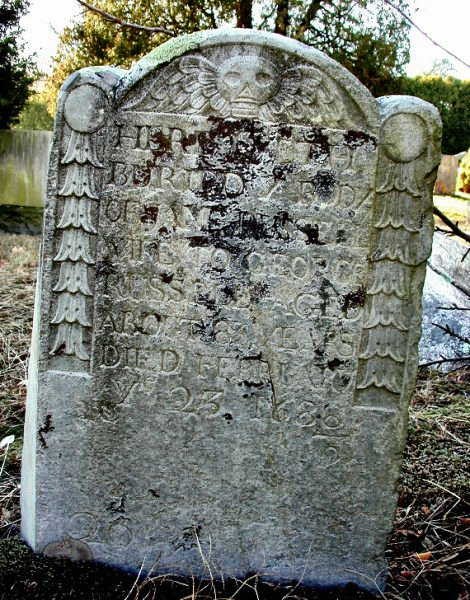
The settlement of Hingham by English Puritan settlers began in 1635, but the land of the Massachusetts Indians was not ceded to the townspeople until 1665. The land not already occupied was divided into lots and granted to the “Proprietors of the Common lands.” We know that Purthe was a resident, married to Patience in 1667. He was able to participate in the Third Division of the Uplands, as described below.
On March 10,” …the Proprietors of the Common lands in Hingham, drew their Lots for the Third Division of Conahassett uplands…” Purthe, in partnership with John Langlee, received 16 acres of land in this drawing and a second one that followed. These were on the outskirts of the main town center, and mostly went to the second generation of Hingham sons. The fact that these people were listed as Proprietors means they were already landowners. So, what was Purthe’s relationship with John Langlee? Ancestry trees shows that John Langlee (Langley) was born in England in 1735 and died in Hingham in 1703. He was in Hingham by at least 1665 when his marriage was recorded, married by the same Captain Joshua Hubbard (brother of Hingham’s founder Reverend Peter Hobart/Hubbard) as Purthe and Patience. John Langlee was already a landowner, and it is possible that Purthe needed to be in a partnership to participate in this drawing.
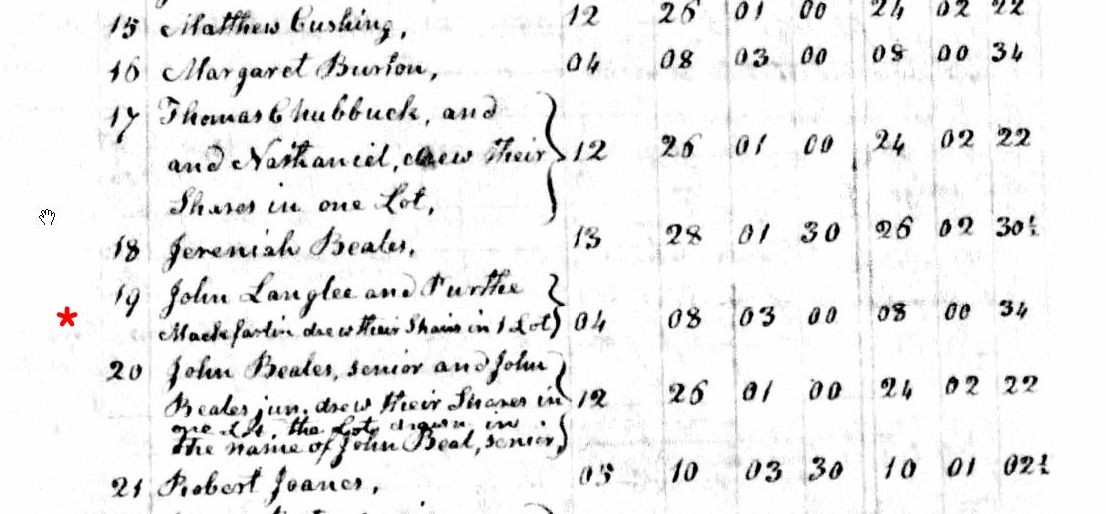
Full image of page 181 is available on Ancestry: https://www.ancestry.com/imageviewer/collections/2495/images/40168_271839__0009-00099?pId=77731390
On page 183, you can see other neighbors, Jacob Beales, father of David Beal who marries Purthe’s daughter Abigail. Also, John Farroes (Farrow), who is described as neighbor in the passage below.
https://www.ancestry.com/imageviewer/collections/2495/images/40168_271839__0009-00100?pId=77731390
Other records show later divisions of the Conahassett common land where Purthe received lot #53 of one acre in another 5th division, and then Lot #96 of 6 acres in the Sixth Division. These additional records can be found online in Ancestry’s Hingham Proprietors Meetings, pages 24, and 79, found online in Ancestry; see sources. It was not clear what year these divisions occurred, they were recorded in Proprietors Meetings in the 1720s.
Page 24: Notice Daniel Stodder, the husband of Purthe’s daughter Margaret is #54

Page 79: Notice John Langlee is present also, as well as John Farrow Jr.

The location of Purthe’s home is described in Thomas T. Bouve’s book: The History of Town of Hingham Massachusetts, published in 1873.
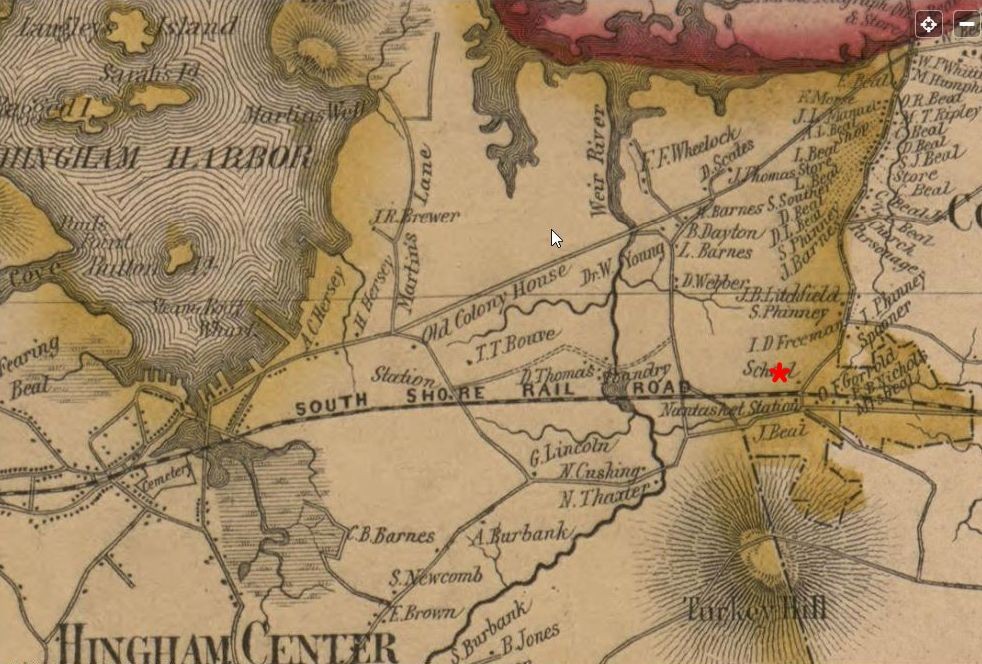
Purthe lived near the Weir River close to the junction of present-day East Street and Hull Street. To quote from Vol. 1, part 1, p. 230: “until reaching the vicinity of Weir River on East Street, then a little travelled lane. Here, however, we should have come upon the farm of John Farrow with whom lived his sons John and Nathan, while beyond and near if not upon the very spot where the Misses Beale now live, was the last residence of Sergeant Jeremiah Beale; and near him his friend and neighbor Purthee McFarlin, the Scotchman, found himself blessed with nine bonny lassies and three sturdy laddies..."
From the 1857 map of landowners in Hingham, you can see the location of all the Beals in 1857, who were neighbors and intermarried with the MacFarland family a couple of times over the years. The red star indicates the approximate location of Purthe’s home.
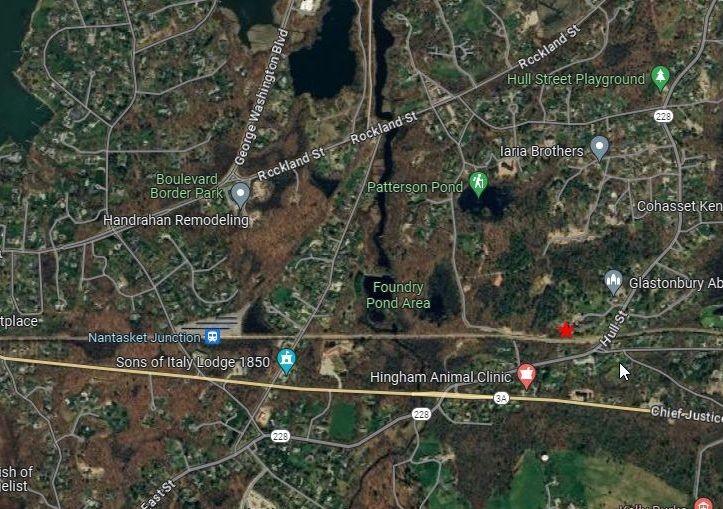
And here is a modern-day Google map with the star at the approximate location of East Street and Hull Street. You can see the original roads on the old map and the current one. East Street turns into Main Street at the border of the adjacent township of Cohasset, which became a separate precinct in 1717, and was incorporated as a separate town in 1770. The land where Purthe lived was just at the edge of Hingham township, while his Beal neighbors were on both sides of the dividing line.
Other property records were discovered in Suffolk County records. Hingham was part of Suffolk County until 1803 when it became Plymouth County. On Sept 9, 1699, Purthe purchased 1 ½ acres in Hingham’s “Swampy Meadow.” (Suffolk Co. Bk. 19, p. 191)
Below are the 12 children mentioned in Bouve’s book. Ten of these children were recorded by the Hingham town clerk. The two youngest children were recorded elsewhere, but with no exact birth date.
1. Patience Mackfarlin, born July 3, 1668

2. Margaret Mackfarlin, born Dec. 26, 1669. Married Daniel Stodder May 26, 1690, in Hingham

3. Martha Mackfarlin, born January 15, 1672, married Matthew Keen Dec. 20, 1698, in Duxbury

4. John Mackfarlin, born March 7, 1674, married Martha Berstow in Scituate

5. James Mackfarlin, born August 11, 1675, married Sarah Lane June 5, 1710, in Hingham

6. Mary Mackfarlin, born July 3, 1677, died Oct. 6, 1686, in Hingham.

7. Hannah Mackfarlin, born March 23, 1678, married Elias Magoon Dec. 19, 1702, in Hingham.

8. Sarah Mackfarlin, born March 7, 1682, died November 2, 1686, in Hingham.

9. Abagail Mackfarlin, born February 10, 1683, married David Beal June 21, 1722, in Hingham.

10. Rachel Mackfarlin, born March 28, 1686, died March 26, 1714, in Hingham.

Death records for both Mary and Sarah in 1686

11. Mary, born April 1689, m. James Churchill Dec. 27, 1716 of Duxbury in Plympton town records. She is not in the Hingham city clerk’s records.
12. Solomon Magvarlow baptized November 1691 in Hingham Church records. His name did not show up in the City Clerk’s records.
Death record for Rachel in 1714

CMW members of Purthe and Patience Russell all descend from the youngest son Solomon, who married Susannah Huit on June 14, 1716, in Hingham, but then moved to Plympton, where he lived till his death on Jan. 3, 1762.
Now back to Purthe:
In 1721, it appears the family was preparing for Purdy’s death by arranging an exchange of his property. On Jan. 26, 1721, son John Mackvarland of Pembroke in Plymouth gave to his “honourable father Purdy MacFarland” of Hingham in Suffolk Co. all his land in Middleborough for 50 pounds already paid. This land consisted of 32 acres, but he was reserving 8 acres for himself. (Plymouth Deeds Bk. 15, p. 123)
Then on Aug. 3, 1721, Purdy Macfarland of Hingham gave to his youngest son Solomon Macfarland of Pembroke all his land in Middleborough. (Plymouth Deeds Bk. 20, p. 83)
There is no will or probate for Purdy, so it is assumed the family took care of Purdy’s property by direct deed transfers.
Purthe’s death is recorded in the Hingham official records here. The clerk who recorded didn’t always stay on the same line, so it is a little confusing to read because the full date is below and reads “December th 2 1721”, while the “22 1719” belongs to the birth record above.

After Purthe’s death one more deed record can be found in the index of Suffolk Co. Deed Book 37, p. 268. On Aug. 3, 1724, Purthe’s son James receives from Purdy “sundry pieces” of land in Hingham.
(Note: the Suffolk deeds are not available online, so I haven’t seen exactly what it says.)
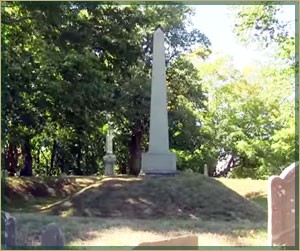
It is said that Purthe and his family members are buried in the Hingham Cemetery, established in 1672, located behind the Old Ship Church, which was built in 1681. It would be expected that wherever the two young daughters who died in 1686 were buried, the parents would be there also. However, the earliest burials of the Old Settlers were in front of the Old Ship Church. They were removed in the 1830s to make way for horse-drawn trolleys. The Settlers’ Monument in the Hingham Cemetery marks their new location.
Sources:
Ancestry records www.ancestry.com
Hingham Records and Hubbard’s Journal Together from 1635 to 1745.
Massachusetts, U.S., Town and Vital Records, 1620-1988 Document page 24, image page 15 of 87, and page 79, image page 42 of 87
https://www.ancestry.com/imageviewer/collections/2495/images/40168_271842__0019-00014?pId=16631937
https://www.ancestry.com/imageviewer/collections/2495/images/40168_271842__0020-00041?pId=16631937
Battle of Dunbar Scottish Prisoners to Massachusetts http://spows.wpengine.com/battle-of-dunbar/dunbar-documentation/george-sawin-stewart-documents/
Family Search Catalog records at https://www.familysearch.org/
Deed Records in Plymouth County and Sussex County Massachusetts
Vital Records of Hingham Massachusetts, Vol. 1 1645-1803. Film #107944625
Map of the county of Plymouth, Massachusetts 1857 from the Library of Congress:
https://www.loc.gov/resource/g3763p.la000319/?r=0.239,0.045,0.071,0.042,0
Old Ship Church in Hingham: Wikipedia: https://en.wikipedia.org/wiki/Old_Ship_Church
The History of the Town of Hingham Massachusetts, by Thomas T. Bouve, 1893. Available online in various places such as https://archive.org/
https://archive.org/details/historyoftownofh0203hing/page/n5/mode/2up
Vol. 1, p. 230, p. 363
Vol. 2 MacVarlo in index on p. 44, 59, 109, 359, 401, 412
Vol. 3 MacVarlo in index on p. 5, 47, 48, 116, 142, 193, 197, 218, 295 These are all in reference to family births and marriages.
The History of the Town of Holland Massachusetts, by Rev. Martin Lovering, 1915.
https://dn790006.ca.archive.org/0/items/historyoftownofh1915love/historyoftownofh1915love.pdf
The McFarland family genealogy is on pp. 587-628, pdf document pages 631-678.
The Dunbar Martyrs: Scottish Prisoners of War in Durham Cathedral, 1650, by Simon Webb, pub. 2018.
Scotland’s People Old Parish records to search for birth records https://www.scotlandspeople.gov.uk/ (none found)